
Over the next three years, Latvia will contribute to strengthening the role of digitalisation in development cooperation, working alongside other European Union (EU) Member States to promote projects in the Eastern Partnership and EU enlargement countries. Latvian businesses, public sector institutions, universities and civil society organisations will also be encouraged to contribute their expertise and experience to support the digital transformation, economic development and closer EU integration of partner countries.
At the end of October, a consortium of development cooperation organisations from eight EU Member States signed an agreement to implement the second phase of the Digital for Development Hub (D4D Hub), which will run until 2029. Although 18 EU Member States are involved in the initiative, the Hub's Secretariat functions and day-to-day operations are carried out by a consortium of organisations from eight countries. Latvia is represented in the consortium by the Central Finance and Contracting Agency (CFCA), which, together with partner organisations from Germany, Spain, Italy, Belgium, Estonia, France and Finland, will contribute to the continued operation of the platform.
The D4D Hub is the Team Europe platform for digital development cooperation. It facilitates partnerships, supports the development of investment projects and connects the expertise of European public sector institutions, businesses, academia and civil society organisations with the needs of partner countries.
During the new phase, particular attention will be given to mobilising investment and achieving tangible economic results. At the same time, European countries have emphasised that digital development must be human-centred, secure and sustainable. This means promoting digital inclusion, strengthening cybersecurity, developing high-quality public services and ensuring data protection.
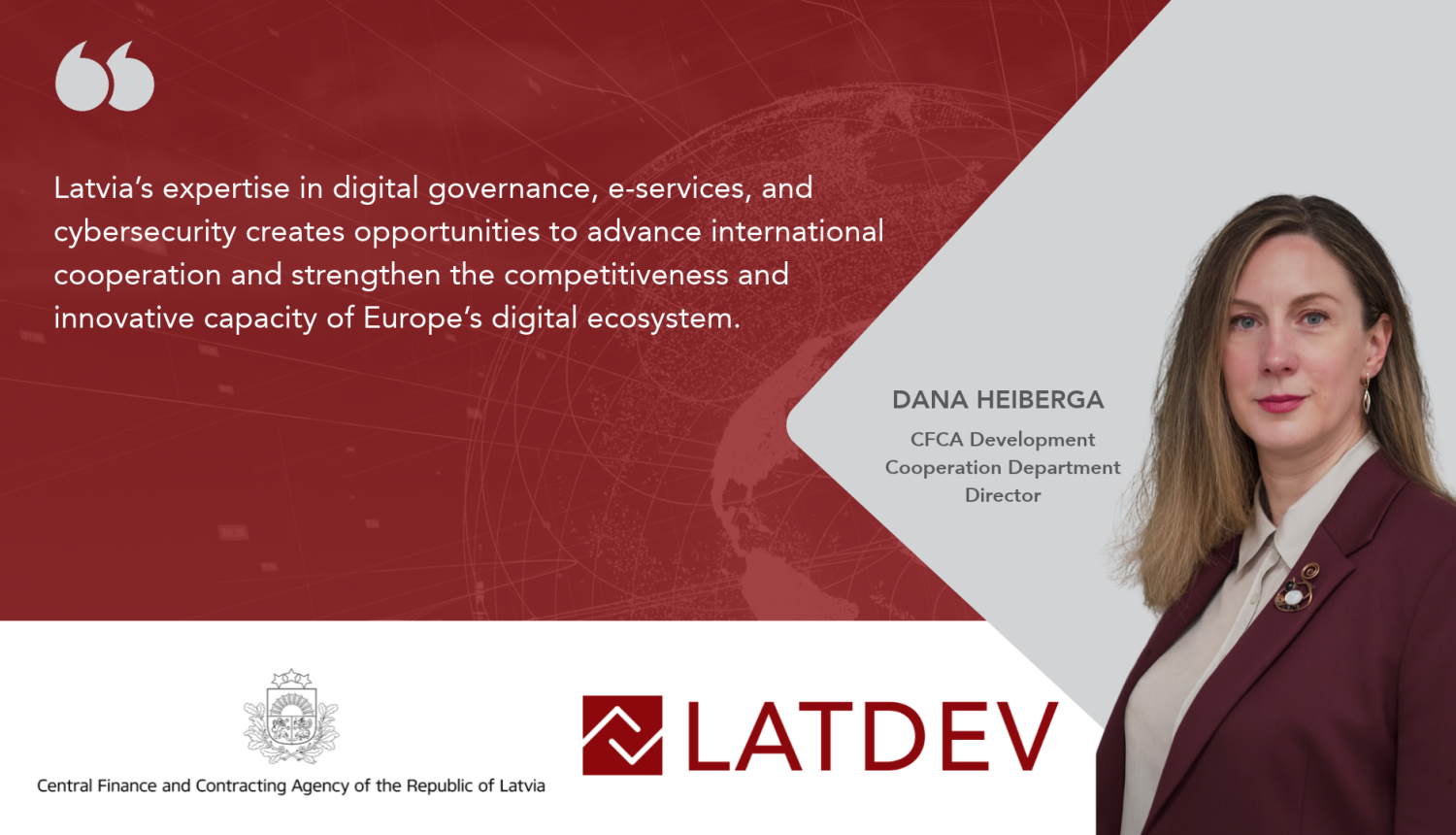
“Latvia has built up considerable expertise in digital governance, e-services and cybersecurity. Participation in the D4D Hub provides an opportunity to put this experience to use internationally while fostering new cooperation between EU businesses, universities, research organisations and experts. This strengthens the competitiveness and innovation capacity of Europe's digital ecosystem while supporting the digital transformation, resilience and sustainable development of EU neighbouring countries,” says Dana Heiberga, Director of the Development Cooperation Department at CFCA.
Latvia's involvement in the D4D Hub Secretariat is particularly important at a time when the EU is placing increasing emphasis on Ukraine's recovery, the EU enlargement process and the closer integration of Eastern Partnership countries with Europe. Latvia's experience in digital governance can support these countries in their reform and modernisation efforts while opening up new opportunities for cooperation for Latvian organisations.
The total budget for the second three-year phase of the D4D Hub is EUR 11.31 million. The funding will cover the operation of the platform's Secretariat, partnership development, project preparation, expert engagement and the coordination of international cooperation. The Latvian Ministry of Foreign Affairs will contribute EUR 20,000 in co-financing over the three-year period.
However, the platform aims to help mobilise significantly greater investment than its own operating budget. The D4D Hub identifies promising projects and helps secure funding from European and international financial instruments, including European Commission programmes, the Global Gateway initiative, the European Investment Bank and private sector investors. In this way, the platform acts as a catalyst, helping to prepare projects and connect them with broader sources of financing.
The main areas of cooperation include energy, information and communications technology infrastructure, digital public services, the use of artificial intelligence in public administration and business, and the digitalisation of society and the economy as a whole. At the same time, the European approach requires these solutions to comply with high standards of data protection, cybersecurity, responsible governance, human rights and environmental sustainability, helping to build a secure and resilient digital economy.
The D4D Hub operates across several regions: the Eastern Partnership and EU enlargement countries, the Middle East and North Africa, Sub-Saharan Africa, Latin America and the Caribbean, and Asia and the Pacific.