Īres mājokļi

Current project status: FEA coordinated with CFLA and FM, 22.12.2025. Cabinet decision on initiating the PPP procurement procedure

Projekta kontaktpersonas: 

Inga Pole, VAS “State Real Estate”, inga.pole@vni.lv   

Iveta Strazdiņa, VAS “State Real Estate”, strazdina.iveta@vni.lv  

Project website

  • Project goal: Construction of affordable rental housing in municipalities.
  • Public partner: Ministry of Finance, VAS “State Real Estate”.
  • PPP model: Design, build, finance, maintain (DBFM).
  • CAPEX: 150.1 MEUR excluding VAT (in 2025 prices).
  • Project accounting: Off-balance sheet project.
  • Term: 27 years (2 years construction + 25 years maintenance).
  • PPP contract start date: Provisionally 2027 - early 2028.
  • Construction work completed, object available: Provisionally end of 2029 - beginning of 2030.
  • PPP contract end date: Provisionally end of 2056 - beginning of 2057.
  • PPP procurement: Competitive procedure with negotiations in two stages (qualification, submission of tenders) or competitive dialogue

By Order No. 509 of the Minister of Finance of December 21, 2023, a steering group “On the establishment of a steering group for the development of private and public partnership solutions for low and affordable rental apartments” (Steering Group) was established, as a result of whose work the Cabinet of Ministers approved the informative report “On the development program for affordable rental apartments” on June 11, 2024.

īres mājokļu programma

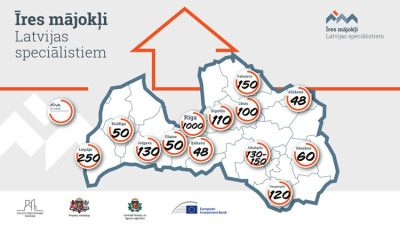
During the development of the report, the management group found that due to price differences in the regions, it is currently impossible to build housing at market construction costs - construction costs and the solvency of the population are not in balance, construction costs exceed the income level of the population of the municipalities and the further ability to pay rent for an apartment. Thus, an affordable rental apartment program has been launched, which will allow providing modern, energy-efficient and affordable apartments for specialists and their families in sectors essential to the state and municipalities (teachers, firefighters, police officers, military personnel, state and municipal employees, etc.). Currently, it is planned to build at least 1,000 rental apartments in Daugavpils, Jelgava, Jēkabpils, Liepāja, Rēzekne, Valmiera, Ventspils, Kuldīga, Ķekava, Olaine, Alūksne, Cēsis, Sigulda and Riga, with total investments of at least 100 million euros.

Municipalities will have to ensure the allocation of land plots and co-financing of rental apartments, taking into account the solvency of residents and the market situation.

The implementation of the program in Latvia has been entrusted to the State Enterprise “Valsts nekustamie īpašumi” (VNĪ).

In July 2024, VNĪ signed an agreement with the European Investment Bank (EIB) to develop financial economic calculations and provide consulting services for structuring the program. A consulting agreement of this size with the EIB is being concluded in Latvia for the first time – it will ensure that international institutional investors could also finance the construction of affordable rental apartments. The project is being developed as an off-balance sheet project according to the “ design, build, finance, maintain, manage ” model, with public sector accessibility payments being included in the state and local government budget expenditures from 2030, simultaneously with the availability of housing for residents. In addition, the program provides that both during the project implementation and after the expiration of the PPP contract, the municipality will own the land and the constructed housing of the highest possible quality.

On October 2, 2024, 13 municipalities concluded letters of intent on conceptual participation in the program, and the development of financial economic calculations has begun.


The Ministry of Finance, in cooperation with the Ministry of Smart Administration and Regional Development, the Central Finance and Contracts Agency and the State Joint Stock Company "Valsts nekustamie īpašumi" (VNĪ), has assessed the questions of several municipalities regarding the legal aspects related to the municipality's ability to conclude an agreement with VNĪ on joint participation in the 1st lot project of the public-private partnership (PPP) program "Rental Housing for Latvian Specialists".

The opinion concludes that the agreement is concluded in accordance with Section 6, Part Two of the Public-Private Partnership Law (hereinafter – the Law) and its purpose is to determine cooperation and procedural issues, including the conduct of the partnership procurement procedure. (In accordance with Section 6, Part Two of the Law, in the event that one public-private partnership agreement is concluded by several public partners, representatives of the public partners shall agree in writing on the determination of the lead public partner and the conduct of the partnership procurement procedure, as well as on the procedure for mutual cooperation and information exchange.)

Program basis and government decisions 

The Affordable Rental Housing Program has been developed and approved at the Cabinet level:

  • On June 11, 2024, an information report on the affordable rental apartment development program was approved;

  • On December 22, 2025, an informative report was adopted on the implementation of Lot 1 of the program and the participation of local governments, as well as Cabinet Order No. 900 on the initiation of the PPP procedure.

These decisions confirm that the program is a national initiative with a clear legal and institutional framework.

The role of the VNI in the program

 According to the approved model, the VNĪ acts as a representative of the public partner – both the state and local governments. This means that the VNĪ:

  • develops and coordinates financial and economic calculations in cooperation with the European Investment Bank, the Central Finance and Contracts Agency and the Ministry of Finance;

  • prepares and organizes the PPP procurement procedure;

  • after the procurement is completed, the PPP contract is concluded and monitored together with the participating municipalities.

Such a centralized approach allows combining the needs of several municipalities into one project and ensuring more efficient project implementation.

Duties and rights of local governments 

Municipalities participate in the program as public partners , and their role includes:

  • securing the land necessary for the implementation of the project;

  • tenant selection and co-financing of rent;

  • determining the conditions for a service of general economic interest (SGEI) in the binding regulations of local governments;

  • making availability payments during the availability period.

At the same time, municipalities retain full control over their autonomous functions and budgetary decisions.

The agreement with the VNĪ is a procedural cooperation document that provides for:

  • joint organization of the procurement procedure;

  • mutual cooperation during the program preparation phase.

It is important to emphasize:

  • the agreement does not imply any financial commitment;

  • it does not transfer the autonomous functions of the local government to the VNĪ;

  • it does not replace the council's decision on long-term commitments.. 

Decisions on:

  • undertaking long-term financial commitments,

  • further participation in the project,

  • final conclusion of the PPP contract

will be adopted after the completion of the procurement procedure , when specific offers and their financial impact on the municipal budget are known. These decisions remain solely within the competence of the municipal council.

Conclusion

The participation of municipalities in the PPP program “Rental Housing for Latvian Specialists” by concluding an agreement with the VNĪ on the organization of the procurement procedure is legally justified and institutionally balanced. It ensures effective cooperation between the state and municipalities, while fully preserving the autonomy, decision-making rights and responsibility for the use of public finances of municipalities. Both municipalities and the state retain the right to refuse to implement the program in the event that the results of the public-private partnership procurement significantly differ from the initially planned conditions. The public-private partnership agreement is signed only after positive decisions have been made by all involved public partners, and it is signed by the VNĪ in accordance with the requirements of the PPP Law and inter-institutional agreements with municipalities that are yet to be concluded.